What is the best fish tank pump
- Share
- publisher
- David Yoon
- Issue Time
- Sep 4,2026
Summary
The best fish tank pump depends on flow, head height, water type, noise, efficiency, and maintenance. Buyers should verify performance, materials, safety, and OEM support before purchase.
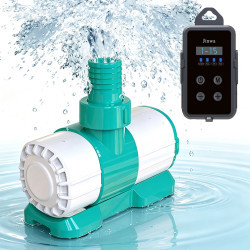
The best fish tank pump is not one universal model. It is the pump that delivers the required water movement, pressure, reliability, material compatibility, and controllability for a defined application. A pump for a quiet freshwater display is not automatically suitable as a sump return, an aquaculture circulation unit, or a permanent marine installation. For overseas buyers, the correct decision starts with the system duty point and ends with documented testing, service support, and repeatable supply.
Match the Pump to the Application
| Application | Appropriate pump category | Practical sizing lens | Procurement checks |
|---|---|---|---|
| Freshwater display aquarium | Internal circulation pump, powerhead, or submersible aquarium water pump | Published aquarium guides use approximately 3× to 5× nominal tank-volume turnover as a starting point, not a guarantee [3][4]. | Adjustable flow, guarded intake, stable mounting, low vibration, and suitability for the livestock. |
| Filtration, canister, or sump return | Submersible return pump or external water pump | Select delivered flow at the required lift and plumbing resistance, not the free-flow rating. | Pump curve, head height, duty cycle, hose size, restart behavior, seals, and spare parts. |
| Aquaculture or commercial display system | Continuous-duty internal or external water pump, often with more than one pump | Design from required circulation and filtration duty, with allowance for fouling and operating tolerance. | 24/7 rating, redundancy, alarms, service access, energy use, replacement impeller, and batch consistency. |
| Marine or reef system | Corrosion-compatible marine aquarium pump plus circulation or wavemaker equipment where needed | Flow pattern matters as much as nominal turnover; multidirectional circulation is often required [3]. | Confirm exact saltwater approval, wetted materials, seals, controller, cable protection, and corrosion resistance. |
| Quarantine, hospital, or outage support | Air pump with air stone or sponge filter; use a water pump only when water circulation is the actual requirement | Size air output against depth and back pressure, or water flow against the installed duty point. | Check valve, battery or backup behavior, quietness, airline parts, and continuous versus emergency operation [1][5]. |
Freshwater Aquariums and Filtration
For a freshwater display, begin by asking whether the objective is filtration return, surface agitation, or circulation to eliminate dead spots. A small aquarium may already receive sufficient movement from its filter. A long tank, heavily decorated layout, or system with low-flow areas may need a separate powerhead, but excessive flow can disturb fish and force water out of the aquarium [2]. Adjustable output and directional control are therefore often more useful than the highest advertised GPH.
Turnover rules are only a first screen. ManoMano gives at least three times the tank volume per hour as a broad example, while AquaDream gives a general 4–5× target and ModestFish uses four turnovers as a cautious basis for its powerhead recommendations [2][3][4]. These figures should be applied to the actual water volume and then checked against species, aquascape, filtration resistance, and the pump curve. They are not a universal performance specification.
For filtration, distinguish a free-flow aquarium water pump from a return pump. A return unit must lift water to the outlet and overcome pipe, elbows, valves, filter media, and fittings. Ask the supplier for a curve showing flow at the intended head height, plus wattage and current at that duty point. A submersible aquarium water pump can simplify a compact installation, while an external arrangement can preserve tank space and improve service access; each must be assessed against the maker’s installation instructions, priming arrangement, heat transfer, leak control, and available service space.
Aquaculture and Display Systems
Commercial aquaculture, public displays, retail holding systems, and OEM equipment need more than a tank-size rule. Specify the required circulation path, filtration load, operating hours, water temperature, maximum acceptable flow variation, and consequences of a stoppage. A procurement specification should also cover redundant capacity where appropriate, restart after power interruption, intake protection, accessible wear parts, and a documented replacement plan.
A review of five consumer circulation pumps illustrates why catalogue GPH must be treated carefully. In an open-trough test using a hose and a two-gallon container, the reported average results ranged from 149 to 270 GPH [2]. The review did not test vertical lift, plumbing losses, filter media, or in-tank conditions. These figures are useful evidence of one comparative test, but they are not transferable pump curves, current specifications, or proof of suitability for an aquaculture loop.
Marine and Saltwater Systems
A saltwater aquarium pump must be evaluated for corrosion and chemical compatibility, not just flow. One buying guide identifies corrosion resistance as a marine requirement and names stainless steel and epoxy resins as generally hardwearing material approaches, while also noting that they may cost more [3]. Request a complete wetted-material list, elastomer information, shaft or bearing materials, adhesive details where relevant, and the manufacturer’s written approval for the intended salinity. Do not infer marine suitability from a product photograph or from a freshwater rating.
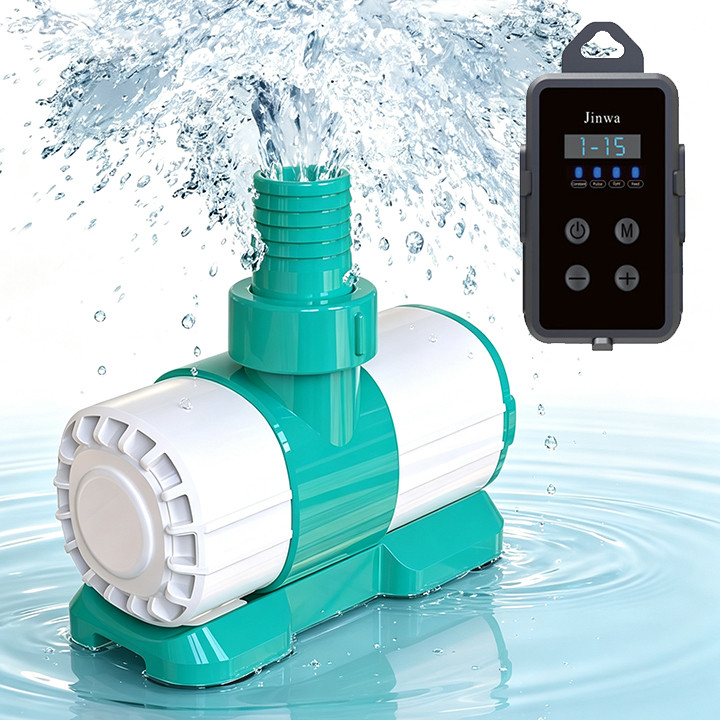
A reef system commonly needs a circulation pattern rather than only a filter return. The supplied marine guidance describes wave makers as a fit for saltwater and reef movement and recommends opposing circulation sources as one way to create multidirectional flow [3]. That is a circulation strategy, not evidence that every wavemaker is suitable for immersion in saltwater. If a buyer requests a dc water pump, define the required power supply, controller interface, speed range, restart behavior, overload protection, and cable or connector sealing. A 24V DC motor example does not establish a universal efficiency claim, certification, or saltwater rating [4]
Selection Criteria for a Professional Purchase
Flow, Head Height, and the Real Duty Point
Record the required flow in L/h or GPH, the vertical lift from water surface to discharge, and every significant restriction. Ask for the manufacturer’s flow curve at that head height. Free-flow or zero-head numbers are useful for comparison but can overstate delivered performance in a return system. For circulation pumps, also describe the desired flow pattern, direction, and livestock tolerance; turnover and in-tank circulation are related but not identical.
Duty Cycle and Service Life
State whether the pump must run continuously, intermittently, or only during an emergency. A commercial pump intended to run 24 hours a day should have a declared continuous-duty rating, thermal protection, restart behavior, and service instructions. Do not convert subjective phrases such as quiet, long lasting, or years of service into a guaranteed life claim. The supplied reviews contain practical observations but no controlled longevity program or standardized life test [1][2]. For OEM sourcing, request warranty terms, expected wear components, spare-part availability, and the supplier’s change-notification policy.
Materials and Saltwater Compatibility
List every wetted component and define the water chemistry and temperature range. Freshwater suitability does not prove marine suitability. For a marine aquarium pump, require written confirmation for the target salinity and operating environment. If the product is private-labeled, the OEM agreement should preserve material traceability and require approval before changing resin, elastomer, magnet, shaft, cable, or seal suppliers.
Noise and Vibration
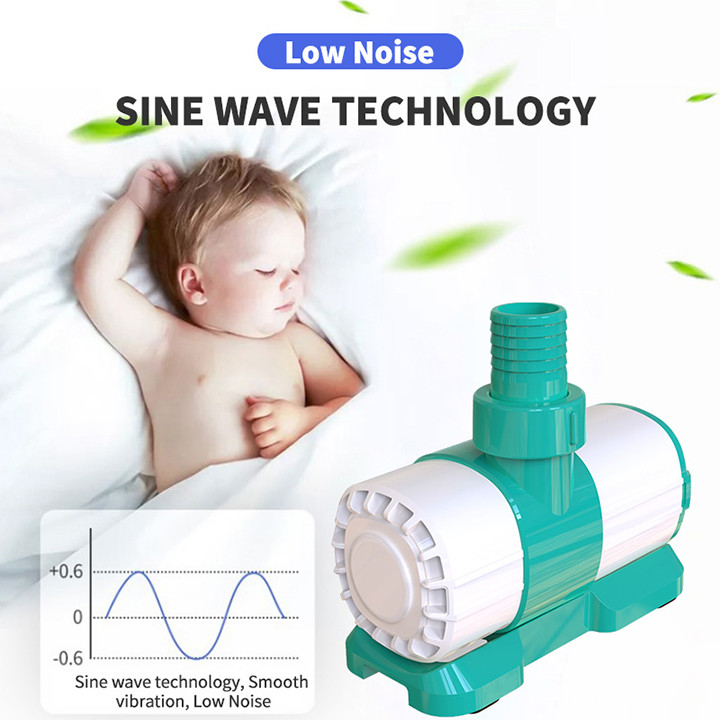
Noise matters in bedrooms, offices, retail displays, and hospitality installations. The air-pump evidence attributes noise not only to the motor but also to placement, vibration, depth or back pressure, open outlets, and resonant surfaces [1]. Ask suppliers for a defined acoustic test condition, distance, load, and dBA result rather than relying on the word silent. During installation, use the specified feet or bracket, avoid resonant panels, and verify that tubing and covers are not rattling.
Efficiency and Control
Compare wattage at the actual operating point, not voltage alone. A 24V label identifies the electrical architecture; it does not by itself prove lower energy consumption. For variable-speed models, document the controller, minimum stable speed, memory after outage, remote interface, and fail-safe state. A distributor should receive consistent datasheets, firmware or controller revision records where applicable, and a clear replacement process.
Safety and Maintenance
Follow the pump manual and local electrical code. Use an appropriately protected outlet such as GFCI or RCD where required, create a drip loop, keep non-submersible electrical equipment dry and ventilated, and isolate power before wet servicing. Check whether the pump may run dry, whether the intake requires a guard, and whether the unit must be fully immersed before starting. For air systems, a check valve helps prevent back-siphoning, and placing the pump above the water level is preferable where possible [1][5].
Plan maintenance before approving the sample. Inspect intake screens, impellers, seals, brackets, tubing, and connectors; remove deposits according to the manual; and keep replacement parts available. For air pumps, blocked air stones, kinked tubing, worn diaphragms, and dusty ventilation openings can reduce output or increase noise [5]. For water pumps, obtain the maker’s cleaning interval and impeller-care procedure rather than inventing a generic schedule.
Application-Oriented Recommendation Framework
- Classify the job. Mark the request as filtration return, freshwater circulation, aquaculture duty, marine circulation, or aeration.
- Define the duty point. State net water volume, target flow, head height, plumbing route, operating hours, temperature, and water chemistry.
- Screen the flow. Use the published 3× to 5× turnover guidance only as an initial range; then use the manufacturer’s installed-flow curve and the livestock or process requirement [2][3][4].
- Choose the construction. Compare submersible and external layouts, intake protection, wetted materials, seals, heat transfer, service access, and space around the unit.
- Specify controls and resilience. Define fixed or adjustable output, restart behavior, backup power, alarms, redundancy, controller compatibility, and spare-parts availability.
- Validate a production sample. Measure flow at the real head, inspect noise and vibration under load, confirm power draw, run a leak and restart test, and document the result.
- Lock the supply arrangement. For OEM or distributor programs, agree on approved materials, drawings, packaging, labels, manuals, warranty, change control, MOQ, lead time, and service-part stock.
Installation and Commissioning Checklist
- Verify the voltage and frequency, and inspect the cable and housing.
- Confirm all unions and hose clamps, and ensure the pump cannot detach or run against a blocked intake.
- Confirm the discharge is open and prime an external pump in accordance with its manual.
- Start the unit while observing leaks, unusual vibration, air entrapment, and stable mounting.
- Measure delivered output using a timed-volume test at the actual lift and plumbing configuration.
- Record operating current or wattage, water temperature, noise condition, and controller setting.
- Check that the return does not overflow when power is interrupted and that the pump restarts as specified.
- Inspect the tank or display for dead spots, excessive jet force, fish stress, or disturbed substrate.
- Record a baseline and schedule the first inspection to detect output loss, deposits, impeller wear, or bracket movement.
Bottom Line for Buyers
Choose the best fish tank pump by application, not by the largest GPH number or a generic bestseller label. A freshwater display may favor controllable, quiet circulation; a filtration loop needs verified flow at head height; an aquaculture or display system needs continuous-duty design and service resilience; and a marine installation needs documented corrosion compatibility plus the right circulation pattern. An air pump remains the correct tool for many sponge-filter, quarantine, and emergency-aeration jobs, but it is not a substitute for a water pump. A disciplined RFQ, a measured commissioning test, and a serviceable long-term supply are the strongest basis for an OEM, distributor, or overseas procurement decision.
References
[1]: The 7 Best Aquarium Air Pumps [Tested and Reviewed]
[2]: 5 Best Water Pumps For Aquariums Tested, Compared & Reviewed (2024 )
[3]: Aquarium Pump Buying Guide
[4]: Dive into the World of Aquarium Pumps: Aquarium Pump Essentials
[5]: The Ultimate Guide to Choosing the Best Aquarium Air Pump