How to Choose Aquarium & Water Feature Pumps | Jinwa
- Share
- publisher
- David Yoon
- Issue Time
- Oct 19,2026
Summary
Learn how to choose pumps for marine aquariums and water features. Compare flow rate, total dynamic head, energy efficiency, and variable-speed pump options.

Choosing the right pump for marine aquariums and water features requires more than comparing maximum flow rates. Marine aquarium systems need suitable return circulation, internal water movement, saltwater compatibility, and controlled operating noise. Fountains, waterfalls, and landscape water features require careful consideration of target flow rate, total dynamic head (TDH), plumbing resistance, and long-term operating costs.
For aquarium and pond equipment brands, wholesalers, and project buyers, understanding these requirements helps prevent undersized pumps, excessive energy consumption, poor water circulation, and unnecessary after-sales issues.
- Choose a pump according to the application: marine aquarium circulation and water-feature flow have different requirements.
- Calculate the required flow rate and total dynamic head instead of selecting a pump by maximum flow alone.
- Compare performance curves, power consumption, material compatibility, and control options.
- Variable-speed pumps provide flow adjustment and can help optimize operating conditions when correctly selected and configured.
- B2B buyers should also evaluate sample testing, quality control, OEM/ODM capabilities, documentation, and after-sales support.
1. Understand the Application: Marine Aquariums vs. Water Features
Marine Aquarium Pumps
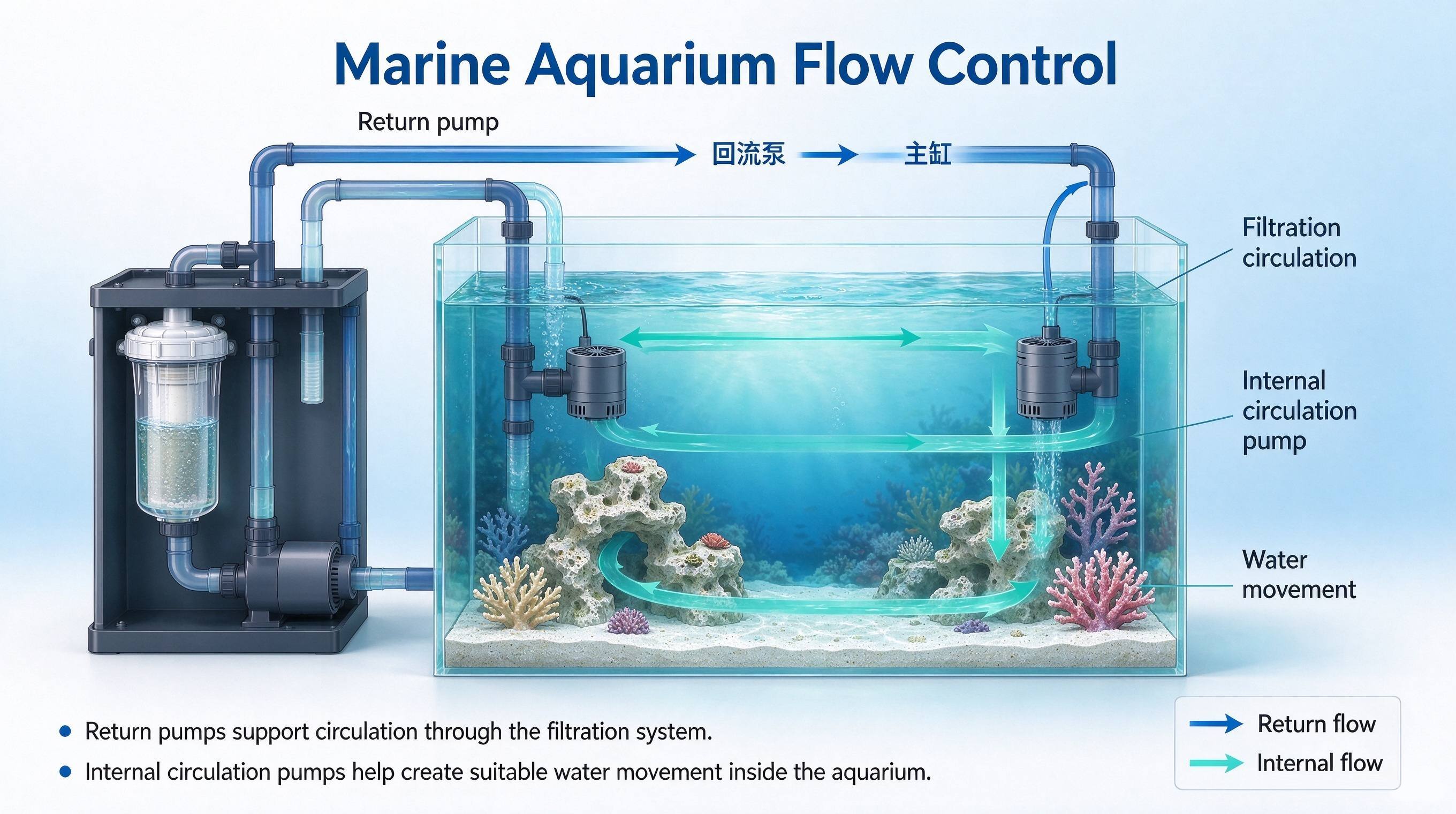
Marine aquariums, especially reef aquariums containing corals, require suitable water movement and effective circulation through the filtration system. Two important pump applications are return pumps and internal circulation pumps, also known as wavemakers.
- Return pumps: Move filtered water from the sump back to the aquarium display tank.
- Circulation pumps and wavemakers: Create water movement inside the display tank and help reduce low-flow areas.
- Protein skimmer pumps: Drive water and air through the skimmer to support its operation.
These pump types perform different functions. A return pump should be selected according to the filtration system's required flow and plumbing resistance, while a circulation pump should be chosen according to aquarium layout, livestock requirements, and the desired water movement pattern.
Fountains, Waterfalls, and Landscape Water Features
Water features have different operating requirements. A small fountain may need a modest flow rate, while a wide waterfall or a feature with a significant vertical lift may require a pump capable of delivering sufficient flow against higher resistance.
When selecting a pump for a water feature, consider:
- The desired visual effect and water flow.
- The vertical height between the water source and discharge point.
- The diameter, length, and layout of the plumbing.
- Fittings, valves, filters, and other equipment that add flow resistance.
- Expected operating hours, maintenance requirements, and electricity costs.
A pump with a high advertised maximum flow rate may not deliver that flow once the actual installation conditions are taken into account.
2. How Do You Determine the Required Pump Flow Rate?
The required flow rate depends on the application, system volume, desired circulation, and hydraulic resistance. For aquarium return systems, a preliminary estimate can be made using the following formula:
Required Return Flow Rate = Effective System Water Volume × Target Turnover Rate
For example, if an aquarium system contains 300 liters of effective water volume and the chosen design target is four times the system volume per hour:
300 L × 4 = 1,200 L/h
This is an illustrative calculation, not a universal recommendation. The appropriate target depends on the aquarium design, filtration equipment, overflow capacity, plumbing, and the manufacturer's guidance. Internal circulation inside a reef tank should be considered separately from the return flow through the sump.
For fountains and waterfalls, flow requirements also depend on the width of the water feature, the desired water-sheet appearance, and the height the water must reach. Consult the equipment manufacturer's recommendations and pump performance curves before finalizing the selection.
For additional aquarium water-flow guidance, see Bulk Reef Supply's aquarium water-flow resource.
3. Understand Total Dynamic Head (TDH)
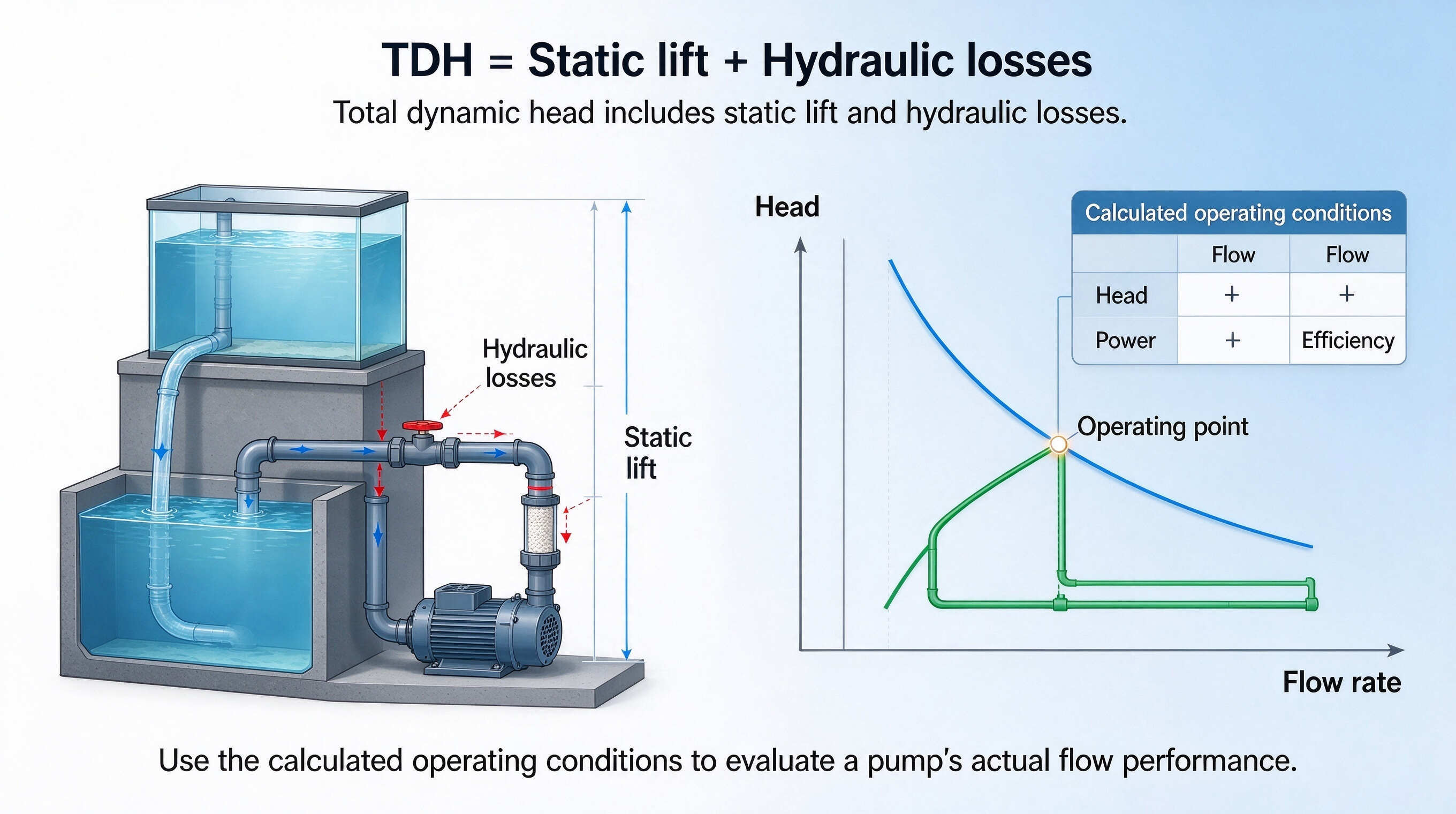
Total dynamic head is an important factor when selecting pumps for waterfalls, fountains, and other installations with plumbing resistance. It accounts for the static lift and the losses caused by water moving through pipes, fittings, valves, and connected equipment.
TDH ≈ Vertical Lift Height + Equivalent Head Loss from Plumbing and Equipment
For example, a system with a vertical lift of 1.5 meters and estimated plumbing losses equivalent to 0.5 meters has an approximate total dynamic head of 2.0 meters.
This is a simplified example. Actual friction losses depend on the flow rate, pipe diameter and length, fittings, valves, and system layout. For more accurate pump selection, calculate the system losses and compare the resulting operating point with the pump's performance curve.
For further guidance, consult OASE's guide to calculating total dynamic head.
4. Variable-Speed Pumps vs. Fixed-Speed Pumps
Variable-speed pumps allow users to adjust pump output according to system requirements. This can be particularly useful for aquarium applications where water movement needs to be tuned, or for installations where operating conditions change.
| Comparison | Variable-Speed Pump | Fixed-Speed Pump |
|---|---|---|
| Flow adjustment | Output can be adjusted within the supported operating range. | Typically operates at a fixed setting unless an external control method is supported. |
| Energy use | May reduce power consumption when operated at a lower suitable output, depending on pump design and system conditions. | May use more power than necessary if the application does not require its full output. |
| Control options | May support a controller, preset speeds, external control, or other model-specific functions. | Control options depend on the design and available accessories. |
| Typical applications | Marine aquariums, freshwater aquariums, and selected pond systems requiring adjustable flow. | Applications where a stable, fixed operating point meets the system requirements. |
| B2B evaluation | Check adjustment range, controller functions, compatibility, and measured performance. | Check the required operating point, power rating, durability, and installation requirements. |
Variable-speed technology does not guarantee a specific percentage of energy savings in every installation. Actual consumption depends on the pump design, operating speed, hydraulic system, and how the pump is used. Buyers should compare verified performance data rather than rely on general claims alone.
5. Three Typical Pump Selection Scenarios
Scenario 1: A Marine Reef Aquarium at Home
A reef aquarium owner wants reliable sump circulation and suitable water movement around corals. The return pump should match the filtration system's required flow at the actual head pressure, while internal circulation pumps should be positioned and adjusted according to the aquascape and livestock needs.
Selection priority: Appropriate operating flow, controllability, saltwater compatibility, operating noise, and ease of maintenance.
Scenario 2: A Coral Retailer's Holding System
A coral retailer or aquarium wholesaler operates several tanks and needs consistent circulation, dependable equipment, and manageable operating costs. The buyer should evaluate the pump's performance under real installation conditions and consider spare parts and maintenance procedures.
Selection priority: Stable performance, suitable adjustment range, reliability, serviceability, and a practical spare-parts plan.
Scenario 3: A Garden Pond or Commercial Waterfall
A landscaping contractor is planning a pond waterfall and needs a pump that can deliver the desired flow at the installation's total dynamic head. Selecting solely by the advertised maximum flow rate could result in an unsatisfactory waterfall effect.
Selection priority: Flow at the required head, plumbing layout, continuous-duty suitability, maintenance access, and operating cost.
6. What Should B2B Buyers Check Before Choosing a Pump Supplier?
For importers, distributors, aquarium brands, and water-feature equipment companies, pump selection includes both technical evaluation and supplier assessment.
- Application compatibility: Confirm the intended use, water conditions, operating range, and installation requirements.
- Performance documentation: Request flow and head curves, rated power data, dimensions, and relevant technical specifications.
- Quality and reliability: Ask about quality-control procedures, product testing, warranty terms, and available supporting documentation.
- OEM/ODM capabilities: Clarify options for branding, packaging, product configuration, controller customization, and other project requirements.
- Commercial terms: Confirm MOQ, sample costs, lead times, payment terms, shipping arrangements, and spare-parts availability.
- After-sales support: Understand the process for troubleshooting, replacement parts, warranty claims, and technical assistance.
Before committing to a large order, test representative samples under realistic operating conditions. This helps validate product suitability before launch or installation at scale.
7. Frequently Asked Questions
Q1. What is the difference between an aquarium return pump and a wavemaker?
A return pump moves water from the sump back to the display tank, supporting circulation through the filtration system. A wavemaker creates water movement within the display aquarium. The two serve different purposes and should be selected according to their respective flow requirements.
Q2. Is a higher-flow aquarium pump always better?
No. Excessive return flow can exceed the practical capacity of the filtration system, while excessive local water movement may be unsuitable for some aquarium inhabitants. Choose a pump that meets the system's actual requirements and provides appropriate adjustment where needed.
Q3. Why is the actual pump flow lower than the advertised maximum flow?
Maximum flow is commonly measured under specified test conditions. In a real installation, vertical lift, pipe friction, bends, valves, and connected equipment can reduce the delivered flow. Review the pump's performance curve at the expected operating head.
Q4. Are variable-speed pumps always more energy-efficient than fixed-speed pumps?
Not necessarily in every application. A variable-speed pump can help match output to demand, potentially reducing unnecessary power use. The result depends on pump efficiency, operating speed, system resistance, and the required flow. Compare measured or manufacturer-verified performance data for the intended operating point.
Q5. What should I check before using a pump in a marine aquarium?
Check that the pump is specified for the intended saltwater application. Review the materials exposed to water, shaft and seal design where applicable, electrical safety, controller suitability, maintenance requirements, and the manufacturer's operating instructions.
Q6. Why does a waterfall pump need a head-height rating?
The pump must overcome the vertical lift and the hydraulic losses in the plumbing. A pump may have a high maximum flow rating but deliver much less flow at the required head. Compare the system's estimated TDH with the pump's performance curve.
Q7. How can a distributor or brand request pump samples or an OEM/ODM quotation?
Prepare the application, target flow rate and head, water conditions, control requirements, estimated annual demand, target market, and any branding or packaging needs. Share these details with the manufacturer to help determine model suitability, sample arrangements, MOQ, lead time, and customization options.
8. Conclusion: Choose a Pump Based on the Complete System
Choosing the right pump for a marine aquarium or water feature starts with understanding the application and calculating the required operating conditions. Flow rate, total dynamic head, energy use, water compatibility, control options, and maintenance requirements should be considered together.
For B2B buyers, the right decision also depends on product documentation, sample validation, quality control, customization capabilities, and long-term supplier support. A system-based selection approach can help reduce mismatches and improve reliability throughout the product's service life.
Find the Right Pump for Your Next Project
Jinwa Aquatics specializes in variable-speed aquarium and pond pumps, supporting B2B customers with product selection and OEM/ODM solutions.
Share your application, target flow and head, control requirements, and estimated order quantity to discuss a suitable pump solution.
Request a QuoteReferences and Further Reading
- Bulk Reef Supply — Science of Water Flow. Background information on water movement in reef aquariums.
- OASE — How to Calculate Total Dynamic Head. Guidance for understanding head and pump selection in pond and water-feature systems.
- POND Trade Magazine — A Contractor's Guide to Choosing the Right Pump for Ponds and Water Features. Practical industry guidance for water-feature pump selection.
Note: Flow-rate calculations in this article are illustrative examples, not universal design standards. Always confirm application requirements and consult the relevant pump performance curves, installation instructions, and manufacturer specifications before making a final selection.